Tile Adhesives: Types, Characteristics, and Selection Criteria

The essentials you need to know about this fundamental construction material, what to look out for, and how to choose the ideal adhesive for your project so that it remains unaltered over the years.
Behind every successful tiled surface - whether it is a modern bathroom, a highly demanding commercial space, or an outdoor architectural application - lies a material that often goes unnoticed but determines the durability and long-term performance of the construction project: tile adhesive.
This specialized bonding material is designed to ensure strong adhesion and resistance to moisture, thermal fluctuations, and mechanical stress. Choosing the right adhesive is not just a technical detail, but a critical factor that affects the stability, aesthetics, feel, and, naturally, the lifespan of the entire application.
The Main Types of Tile Adhesives
Tile adhesives are divided into three main categories according to the modern European standard EN 12004, based on their chemical composition and mode of action.
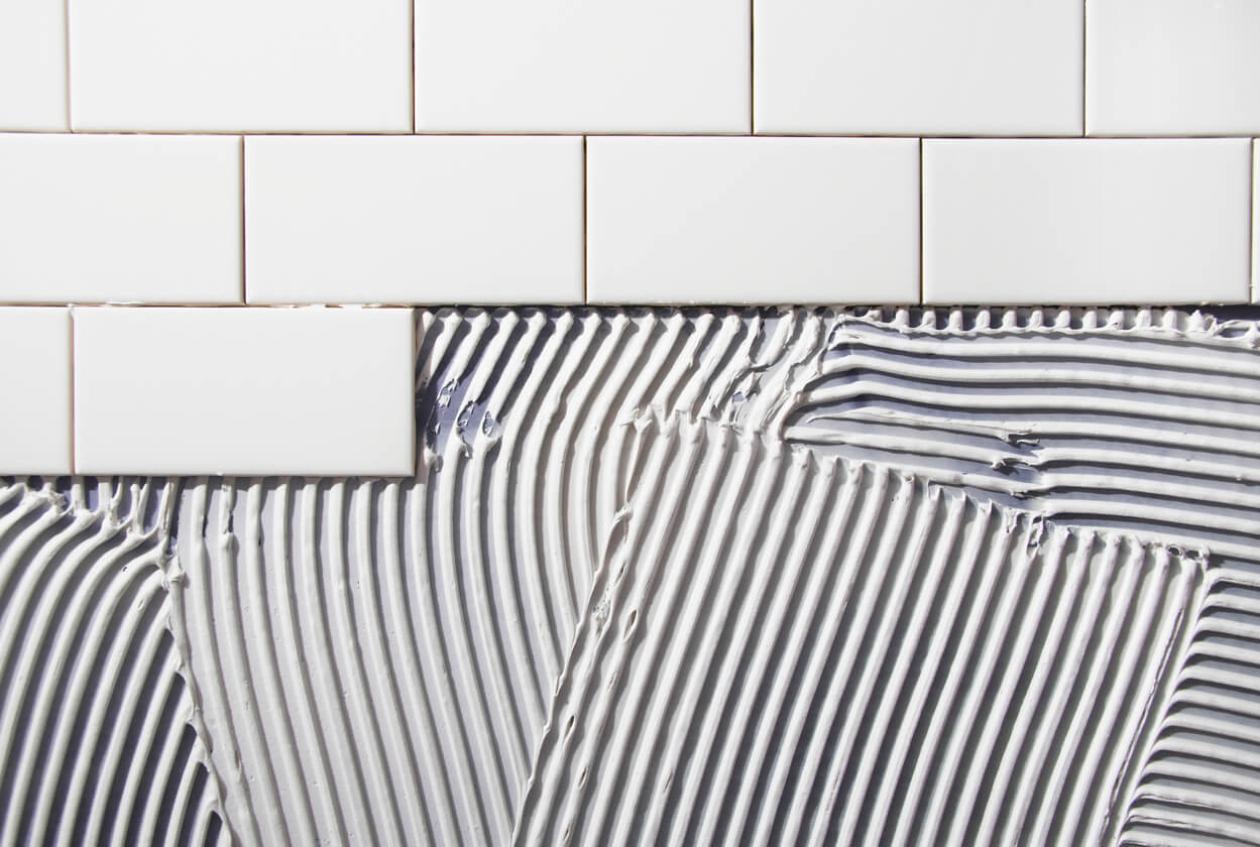
Cementitious Adhesives (Type C): The first and most widely used category, these come in the form of a dry white powder and are activated (mixed) by adding water. They are the most common choice for wall and floor applications, offering high mechanical strength and versatility across a variety of substrates, especially when modified with polymer additives for improved adhesion and elasticity.
Dispersion Adhesives (Type D): The second category consists of ready-to-use adhesives based on organic binders, primarily synthetic resins. They are used almost exclusively for interior applications with smaller tiles where high mechanical strength is not required and heavy moisture is absent.
Reaction Resin Adhesives (Type R): The third category includes products like two-component epoxy adhesives, which cure through a chemical reaction. They are characterized by exceptionally high resistance to mechanical loads, moisture, and chemicals, making them suitable for highly demanding environments such as industrial spaces, swimming pools, and specialized commercial installations (e.g., chemical laboratories).
It is worth noting that product codes provide immediate information regarding the type and strength of each adhesive. For instance, among cementitious adhesives, C1 is the standard subcategory, while C2 is the improved version suitable for more demanding work.
Furthermore, designations like C2TE, C2TES1, etc., indicate additional properties and enhanced features, which are easily explained by the following standard classification table (for cementitious adhesives):
C: Cementitious Tile Adhesive
1: Normal Adhesive
2: Improved Adhesive
F: Fast-setting Adhesive
Τ: Adhesive with Reduced Slip
Ε: Adhesive with Extended Open Time (available only in C2 improved adhesives)
S1: Deformable (Flexible) Adhesive
S2: Highly Deformable (Highly Flexible) Adhesive
Note: A material that works hand-in-hand with tile adhesive is tile grout, which is placed between the tiles. Since grout must also share similar properties (abrasion and moisture resistance, easy workability, smooth texture), an excellent choice for this is the FixoGrout One.
Tile Types and Their Particularities
Tiles are not a single, uniform material; they are distinguished into different types with distinct physical and technical properties, which decisively influence the choice of the appropriate adhesive. The ideal tile adhesive is essentially determined by the type of tile it will "embrace" and coexist with for decades.
Ceramic Tiles: These are among the most common tile types and feature a relatively porous structure, which favors adhesive bonding. Here, selecting the right adhesive depends not only on the tile material but also on its size, the substrate, and the conditions of use. For small ceramic tiles installed in dry interior spaces with limited stress, a standard C1 cementitious adhesive may suffice. For larger tiles or applications with higher demands regarding strength, moisture, or thermal changes, improved C2 category adhesives are preferred.
Porcelain Tiles: These exhibit exceptionally low water absorption and high density, making them more demanding to bond. In these cases, high-performance cementitious adhesives with enhanced adhesion and deformability (e.g., C2 category) are required to ensure a secure and long-lasting bond.
Natural Stone: This category includes marble, granite, and slate, and varies greatly depending on the specific stone type, both in terms of absorption and sensitivity to chemicals. For this reason, adhesives that do not cause discoloration or warping are required (e.g., C2 category with additives), often featuring a white base and high stability.
Glass Tiles: Due to their non-absorbent and smooth surface, glass tiles require special high-adhesion adhesives that are white, often resin-based, or high-performance cementitious types (C2TE or C2TE S1) with polymer additives to ensure a strong bond without slipping or failing on the substrate.
The Ideal Adhesive per Space / Room
The area of application is also a deciding factor when selecting a tile adhesive, as environmental conditions directly affect its mechanical and chemical behavior. In low-stress interior spaces like bedrooms or living rooms, standard or improved cementitious adhesives can be used, as they meet stability requirements without a specific need for high moisture or thermal resistance.
In high-moisture spaces areas with increased humidity like bathrooms and restrooms, adhesives with high moisture resistance and reduced water absorption are required - typically improved cementitious or resin-modified formulations (C2TE S1) - to ensure long-term adhesion and prevent detachment. In kitchens, where moisture, heat, and grease accumulate, the choice of adhesive must guarantee stability and resistance to thermal and chemical stress, favoring high-performance products with improved polymer additives.
On balconies, terraces, and building facades, performance requirements increase significantly due to temperature fluctuations during periods of extreme heat or severe frost. These scenarios demand highly flexible and deformable cementitious adhesives (S1 or S2) that can absorb substrate movements without cracking or debonding, thereby preventing tiles from breaking or popping off.
Because floors bear greater mechanical loads compared to walls, reinforced cementitious adhesives with high adhesion, suitable for heavy use and frequent traffic (C2TE S1 or S2), are preferred.
Environmental Conditions and Their Importance
Environmental factors are the second critical component in selecting the right tile adhesive, as differing levels of moisture, temperature, and heavy traffic require correspondingly adapted materials.In places with high humidity or continuous contact with water (bathrooms, showers, outdoor surfaces), using products with increased water resistance is vital.
In regions with severe temperature swings (outdoor areas exposed to direct sunlight or frost), highly deformable adhesives are preferred so they can absorb the expansion and contraction of the substrate without failing. Meanwhile, in areas subject to heavy mechanical or operational stress, the choice must turn to reinforced bonding systems that guarantee stability over time.
Ultimately, properly matching a tile adhesive to its environmental conditions is not just a technical detail, but a fundamental prerequisite for avoiding issues like detachment, cracking, and premature wear of the installation.
For this reason, it is never worth compromising the budget or choosing based solely on price; high-quality, premium tile adhesives prove to be the most cost-effective solution in the long run.
As we have seen, the answer to what the "best" or most suitable tile adhesive is depends entirely on the type of tile, the intended use, and the location. Every experienced installer evaluates these parameters and prefers a specific family of high-performance products, chosen both for their incomparable quality and long-term durability, as well as the exceptional workability they offer on the job.