Powderfine Acrylic Gel Eco
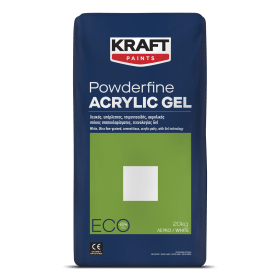
White, Ultra fine-grained, cementitious, acrylic putty in powder form
PowderFine Acrylic Gel is a white, ultra fine-grained putty in powder form. Its advanced formulation contains cement with low CO2 footprint and an ideal combination of acrylic resins and modified inorganic additives that form the Gel mechanism, giving the product excellent workability, extended open time, and moisture resistance. The Gel property gives it a uniquely smooth application and high coverage. The final surface has a velvety texture, free of cracks and imperfections.
Its specially designed composition has been certified for extremely low VOC emissions according to EMICODE EC1PLUS. At the same time, it meets the specifications of the BREEAM GN22 certification (Building Research Establishment Environmental Assessment Method), one of the most widely recognized and stringent international sustainability certification systems for buildings.
It is classified as a GP CS-III Wc0 mortar, according to ΕΝ 998-1.
Advantages
- Excellent workability with extended open time and smooth application.
- Minimizes material loose due to dehydration
- Strong adhesion to the substrate
- Easy to sand
- Exemplary smooth surface
- Resistant to temperature, humidity and alkalinity
- Cracking free
- No dehydration, no shrinkage
- Suitable for use with airless spray system
- Internal-external usage
Product information
Shades:WHITE
Packaging:5Kg, 20Kg
Certifications / Evaluations



Technical Info
Technical Information


Application - Tools


Download the files
General Information
PowderFine Acrylic Gel is suitable for filling and smoothing surfaces like ceiling and walls made of plaster, concrete, gypsum boards, cement board etc. with roughness up to 2mm, which will be coated with paint or wallpaper. When mixed with water, it creates a creamy paste that spreads evenly, without dehydration, giving a smooth, lump-free and highly durable surface while requiring minimal effort from the applicator. No priming is required before application, in most cases. It is superior to traditional oil-putties with time-consuming drying and surface oils-migration over time. It has great resistance to moisture, frost and temperature changes, ease of mixing and application. It dries quickly and can be sanded easily, ensuring fast and reliable completion of work.
How to Use
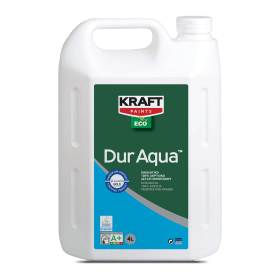
To ensure proper adhesion, the substrate must be clean, sound, and free from dust, oils, lime, tar, and loose or friable materials. Any existing cracks on the substrate must be repaired before application using the appropriate KRAFT PAINTS repairing rmortars. On substrates with high absorbency (e.g., plasterboards, cement boards, etc.), it is recommended to apply Eco Dur Aqua primer by KRAFT PAINTS diluted 1:1 to 1:2 with water.
Caution! The primer must properly be diluted in order to be completely absorbed and avoid film formation to the substrate surface.
In a clean container filled with clean water, gradually add the product under continuous stirring using a low-speed electric mixer. Use 8–8.4 l of water per 20 kg or 2–2.1 lt of water per 5 kg of Powderfine Acrylic Gel. Mixing must be carried out carefully to ensure no dry powder remains on the sides or at the bottom of the container. The product is ready for use when the mixture becomes homogeneous and creamy, without lumps. It is recommended to allow the mixture to rest for approximately 3 minutes, then re-mix before use to fully activate the Gel mechanism. The homogenized mixture should be stirred at regular intervals so that no additional water is required.
The application of Powderfine Acrylic Gel on the substrate is recommended in layers up to 1 mm thickness per coat, using a flat metal trowel and ensuring full coverage of the substrate. On outdoor applications, as well as on surfaces with special problems of cracking or humidity, the addition of mortar additives by KRAFT PAINTS is required, replacing part of the required amount of water, depending on each application.
Apply two layers of Powderfine Acrylic Gel. After 12 hours, the final coat should be sanded with fine sandpaper and dusted thoroughly. The skim-coated surface must be allowed to dry completely before proceeding with priming and painting.
Tools must be cleaned immediately after application with warm water and soap or a detergent solution. Remove as much material as possible from the tools before cleaning.